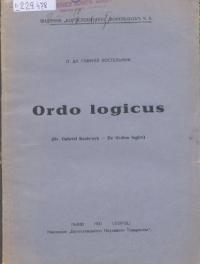
Ordo logicus: Lviv, Printed by „Bohoslovske naukove tovarystvo“ [Theological Scientific Society], 1931, 42 p.
Keywords:
logic, scholasticism, metaphysicsSynopsis
The work examines the errors made by philosophers who confused the logical order and the order of things («ordo logicus» and «ordo realis»). The author notes that the difference between these orders of being lies in transcendence, which separates concepts from things. Concepts are characterised by timelessness, universality and abstractness in relation to things, while things are characterised by temporality, particularity and the wholeness of their properties.
The author emphasises that in the history of philosophy this distinction developed rather slowly, as thinkers repeatedly confused its components. The author illustrates this with examples from the history of philosophy, where such errors arose from the confusion of the object of thought with the act of thinking.
The final section presents an analysis and resolution of paradoxes arising in set theory and the mathematics of infinity by means of traditional (psychological) logic. The author emphasises that the creation of a new mathematical logic only diverts attention from the resolution of these paradoxes, demonstrating this in his polemic with Bertrand Russell.
Contents
I. The difference between logical order and order of things
II. Historical examples of confusion of the logical order and order of things
III. Examples of confusion of the logical order with order of things in mathematics
Downloads