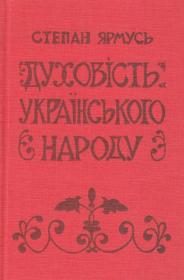
Spirituality of Ukrainian people: Winnipeg, Research institute of volyn No. 51, 1983, 227 p.
Keywords:
spirituality, Hryhorii Skovoroda, Pamfil YurkevychSynopsis
The work offers a religious-philosophical and ethnopsychological interpretation of the spirituality of the Ukrainian people from the pre-Christian era to the twentieth century. The author treats spirituality as a whole that manifests itself in religious beliefs, ethical convictions, culture, creative work, language, and the historical experience of the people. For Stepan Yarmus, it is important to clarify the relationship between pre-Christian and Christian spirituality, the spiritual orientation of Ukrainians, the particular features of how Christianity was received, and the transformations of spirituality under the influence of historical circumstances. The book raises the problems of dehumanization, Sovietization, and the spiritual crisis of the Ukrainian individual.
The Ukrainian philosophical tradition occupies an important place, represented by Hryhorii Skovoroda, Pamfil Yurkevych, and Mykola Shlemkevych. Skovoroda emerges as a thinker for whom philosophy has practical significance and is directed toward the spiritual perfection of the human being. Yurkevych continues this tradition by reflecting on humaneness, self-knowledge, inner peace, conscience, and Christian ethics. In Shlemkevych, the author already identifies a crisis of this tradition: the motif of the "lost Ukrainian man" is linked to dehumanization and the decline of spirituality. Thus, the works of Ukrainian philosophers are viewed as a consistent expression of the transformations of the spirituality of the Ukrainian people and, at the same time, as a reflection of them.
Contents
MY GRATITUDE
PREFACE
Article One
POSITIVE ELEMENTS OF PRE-CHRISTIAN UKRAINIAN SPIRITUALITY
Introductory Remarks
Pre-Christian Religion – Not Necessarily Paganism
"Paganism" – the First Stage of Human Spiritual Development
The Nature of the Old Faith of Our People
The Problem of Changing Religion
A Broader Concept of Spirituality and Its Expression
Pre-Christian Spirituality of Our Ancestors
The Nature of Human Spirituality
Concluding Remarks
Article Two
THE AXIS OF SPIRITUAL ORIENTATION OF A UKRAINIAN
On the Question of Why Ukraine Was Christianized from Byzantium
Introduction
Is There an Axis of Psychological and Spiritual Orientation?
Geographical and Psychological Foundations of Spiritual Orientation
- The Slope of the Earth and the Direction of the Flow of Rivers
- The Concept of the "Danube" and "Viryu"
The Role of Trade, Cultural and Military Relations
The Advantage of Orientation Along the North-South Axis - Orientation, but Not Compliance
- The Psychological and Real Inconvenience of the East-West Orientation
- Insight into the Prospects of Freedom and Authoritarianism
The Spiritual Orientation of the Ukrainian and Christianity
The Conscious Choice of Orthodoxy
The Axis of Spiritual Orientation of Ukrainians and Modernity
Article Three
THE RELIGIOUS CONSCIOUSNESS OF MAN FROM THE TIME OF THE WORD ABOUT IGOR'S CAMPAIGN
Introduction
"Pagan" Elements of the "Word"
Critical Analysis of the "Pagan" Element
- Divination of the Forces of Nature
- Author of "The Tale of Igor's Campaign"
- Mentions of Pre-Christian Deities in "The Tale"
Christian Elements of "The Tale"
Analysis of the Christian Element - The Religious Element of "The Tale" in Mentions of Justice
- A Single Mention of the Name "God"
- The Country of Events of "The Tale"
- Christian Messianism of "The Tale"
Conclusion
Article Four
SPIRITUALITY OF THE UKRAINIAN PEOPLE DURING PRINCELY RUS AND IN LATER TIMES
Introduction
Pre-Christian Spirituality of Ukraine and Its Christianization
Church-Official Spirituality and Spirituality of the People During Princely Rus
The Phenomenon of Teachings as an Expression of the Spirituality of the Ukrainian Person
Book Education as a Sign of the Spirituality of the People
Church Brotherhoods and Book Spirituality
Friendship, Brotherhood and Sociability
Spiritual Messianism of Rus-Ukraine
Conclusions
Article Five
THE MUSE AS A CATEGORY OF SPIRITUALITY
(An Attempt to Understand the Muse of the People as a Psychological-Theological Phenomenon)
Introduction
The Muse Is a Divine-Anthropological Category
- The Muse Is a Natural Talent of Man
- The Nature of the Muse Is Not Universal
- The Structure of the Muse
The Muse as a Biological-Psychological-Spiritual Substance of Man - The Mystery of the "Collectively Unconscious" People
- The Muse as a Component of the Spirituality of the People
- The Ethnicity of the Muse
- The Aesthetics, Ethics and Cosmicity of the Muse
Functions of the Muse and the Fact of Its Historical Evolution - The Muse Is an Expression of the Character of the People
- The Muse Is the Wordless Language of the Soul
- The Phenomenon of the Muse-Glossolalia
The Worldview of Man and Its Expression in Creative Moods - Expression of the Muse in Art
- The Mystery of the Various Forms of the Muse
The Mystery of the Spiritual Monolithicity of the People
Conclusion
Article Six
SPIRITUALITY OF THE UKRAINIAN PEOPLE IN MODERN TIMES
Introduction
The Problem of the Concept of Spirituality and Its Scope
- Intellectualism and Human Spirituality
- Spirituality and Naivety
- Spirit and Letter in the Sphere of Spirituality
Ukrainian Traditional Spirituality and Formal Byzantium - Metropolitan Ilarion I.
- Monk Ivan Vyshenskyi
- Spiritual Ideals of the Cossacks and Mohylyants
Cyril and Methodius and Their Spiritual Ideals - Mykola Kostomarov
- Panteleimon Kulish
- Taras Shevchenko
Spiritual Ideals of Ukrainian Philosophers - Hryhorii Skovoroda
- Pamfil Yurkevych
- Mykola Shlemkevych
The Problem of Ukrainian Spirituality in the 20th Century
(a) Early 20th Century - The Influence of Monasteries on Human Spirituality
- Spirituality of Ukrainians in the Movement for the Independence of Their Church
- Confusion Between Church "Canonicity" and "Non-Canonicity"
- Sovietization of Man and Its Influence on the Spirituality of Ukrainians
(b) Later 20th Century - Spiritual Emptiness of Man After World War II
- The Phenomenon of Culturalism
- Theotokos Spirituality
- Party-Worship, All Kinds of Snobbery and Naivety
Conclusion
APPENDIX
St. Nicholas' Prayer
Epilogue
BIBLIOGRAPHY
LIST OF DONORS
Downloads