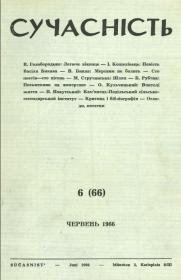
Teachers of Life. In Modernity No. 6 (66), Munich, 1966, pp. 82-88.
Keywords:
nation, spirituality, societySynopsis
Oleksandr Kulchytskyi's essay "Teachers of Life" is dedicated to Mykola Shlemkevych and is an attempt to answer the existential question: "Who is he?" Kulchytskyi is interested in the philosopher's inner choice and in the meaning of his intellectual activity. Shlemkevych emerges as a figure unusual for the Ukrainian emigration: a philosopher who did not stand aside from contemporary life but deliberately placed himself on the boundary between philosophy and journalism. It is precisely here that Kulchytskyi sees his distinctiveness. For Shlemkevych, journalism was a way of reflecting on the spiritual condition of the people and, at the same time, of influencing its future.
The central problem of the essay is Ukrainian spirituality and its contradictory forms. Analyzing Shlemkevych's works, Kulchytskyi turns to the images of the "Gogolian," "Skovorodian," and "Shevchenkian" man. Through them, he reveals different models of the Ukrainian character: from passive immersion in everyday life and self-admiration to spiritual seclusion and the desire to transform the world. Particularly important is the critique of "individualism without individuals" and of excessive emotional dreaminess. The problem that Shlemkevych sees, and Kulchytskyi takes up, is how to transform the emotional, song-like element of Ukrainian spirituality into a creative force capable of giving it form.
Worldview-oriented journalism in Kulchytskyi's treatment emerges as a form of the intellectual's spiritual responsibility to society. Its task is to help the nation change. In this sense, Shlemkevych is for Kulchytskyi a "philosopher in the forum" and one of those "teachers of life" who sought to shape a space for the spiritual renewal of the Ukrainian nation.
Downloads