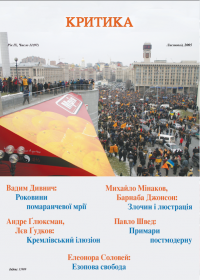
The Massacre of the Postmodern Innocents In Krytyka, No. 11 (97), 2005, pp. 17-19.
Keywords:
Ukrainian culture, nihilism, xenophobiaSynopsis
In this article, the author engages in a debate with the widespread critical interpretation of the role of postmodernism in the Ukrainian cultural context. Pavlo Shved analyzes a number of typical accusations made during a round table discussion organized by the magazine Kino-Teatr on September 11, 2001.
First, Shved rejects the interpretation of postmodernism as an intermediate stage in the development of Ukrainian culture, after which its “true” embodiment is supposed to follow. In his opinion, such an interpretation is methodologically incorrect, since it does not specify the cultural form to which a return is supposed to take place, and therefore leaves the concept of the “normal state of culture” undefined and relative.
Second, the author critically assesses the idea of postmodernism as a “repetition of what already exists,” since such an understanding reproduces the colonial perspective, according to which Ukrainian postmodernism boils down to secondary imitation of Western cultural narratives.
Thirdly, Shved rejects the identification of postmodernism with manifestations of cultural nihilism or the destruction of social norms. In his opinion, such an interpretation masks the possibility of a rational analysis of the real problems of Ukrainian society, the roots of which lie not in “imaginary postmodernism” but in the colonial legacy and inertia of the Soviet cultural model.
Fourth, the author interprets the reduction of postmodernism to a “frivolous infantile game” as a manifestation of xenophobic attitudes toward alternative forms of intellectual culture that go beyond established aesthetic and cognitive paradigms.
The article is included in Pavlo Shved's collection of essays “What Are We Allowed to Laugh At? And Other Essays,” published by Komubook in 2020.
Downloads