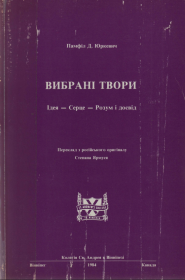
Selected works: Idea-Heart-Mind and Experience (transl. from Russian by Stepan Yarmus):, Winnipeg, St. Andrew's College in Winnipeg, 1984, 167 p.
Synopsis
The collection contains three separate works by Pamfil D. Yurkevych: “Idea,” “Heart,” and “Mind and Experience.” This is the first Ukrainian translation of these works from their original Russian-language editions. The translation was done by Stepan Yarmus. In addition to this edition, there are also translations of these texts into French and English. The book is accompanied by a preface, an afterword, as well as biographical and chronological notes prepared by the translator.
Contents
Photo of Pamfil Danylovych Yurkevych
Foreword
Pamfil Danylovych Yurkevych
(a) Brief biographical information
(b) Chronological data
IDEA
Definitive concept of an idea Forms of cognition
The problem of consciousness and world perception
Idea – a problem of philosophy
Idea – a necessary assumption of science
Idea – the basis of phenomena
Ideas – eternal spiritual elements of the world
Idea – the divine and intelligent in the cosmos
Idea – the basis of everything immortal, beautiful, and real
Plato's science of ideas – incomplete
Idea – the form of an object
God – not an idea, but self-awareness, unconditional thought and reality
Contradictions between Plato and Aristotle
The philosophy of modern times and the problem of pre-experiential ideas
Criticism of the assumptions of Cartesian philosophy
The place of the world – God
Ideas, the essence of the world, substances
Being and spirit. The universe and the monad
The pure monad is God
The significance of the critique of pure reason
The problem of matter and the form of cognition
A critical review of new teachings about ideas
The idea as a dialectical process
The dialectical process and the absolute. The process of ideas
Logical idea. The general essence of the idea
The idea as pure being, or nothingness. The abstractness of the idea
Some critical comparisons
Final conclusions and explanations
The difficulties of philosophy. Theosophy, materialism, idealism
Our most essential thing
HEART
- “Heart” as understood by the authors of Holy Scripture
Introduction
The essence of the “heart”
The importance of the teachings of the Holy Authors
The “heart” and “head” of man
The “head” and “face” of man in Holy Scripture
Biblical teaching and science
The deeper essence of the soul
The essence of the soul is not in thinking
Conscious activity of the soul and the brain
The facts of physiology do not contradict biblical science
The organ of the soul is the whole body of man
Thinking is not the depth of the heart
The essence of the soul is inaccessible
The tree of knowledge is not the tree of life. The value of experiences and knowledge
The slowness of the mind
The apparent and actual state of man
The problem of the autonomy of the mind
Psychology and the essence of the human soul
Personality and its concreteness
The shortcomings of mysticism
- Practical applications
Personality is not subject to any mechanism
The problem of causality in spiritual life and religious consciousness The source of moral phenomena is the godlikeness of man
The weakening of the heart. The necessity of grace
The legal and moral aspects of deeds of truth
The laws of justice
The moral is not without feat
The problem of legislation
III. Final remarks
Legislation and the power of temptation (trial of character)
Moral activity. The oil of love and its lamp
The voice of conscience
Burning with love for one's neighbor
Conclusion
MIND AND EXPERIENCE
Introduction
Some remarks and definitions
Dominant worldview beliefs
Subject of this work
Plato's science of the mind
General human meaning and ideas
Explanation of Socrates' dialogue with Theaetetus
Human speech and ideas
Form of abstract thinking and ideas
The discovery of the higher essence of things and ideas
The existence of things
The substantiality of ideas
The idea of good (transcendent), to agathon
The formal quality of ideas
Ideas – the discovery of the essence of things
Two eras in the development of science
The influence of Platonic thought on the development of science
A new direction – criticism of pure reason
The science of experience
Kritik der reinen Vernunft
Phenomena and representations
Kant's functions of the subject (experience)
The compatibility of the heterogeneous – imaginary
Criticism and explanation
Kant's functions of the knowing subject
The basis of the differences between Plato and Kant
Kant's shortcomings
The consequences of Kant's conclusions
Corrections to Kant
The doctrine of schemata
Inductive and deductive methods
Elucidation of Kant's position
Elucidation of Plato's position
The fallacy of Kant's doctrine of experience
Afterword
Downloads