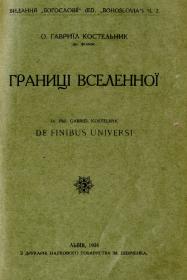
Boundaries of universe: Lviv, Naukove tovarystvo imeni Shevchenka [Shevchenko Scientific Society], 1924, 60 p.
Keywords:
metaphysics, Immanuel Kant, spaceSynopsis
The work proposes a resolution of the antinomy of space formulated by Immanuel Kant. Havryiil Kostelnyk sets out his own view on the finitude, infinitude, emptiness, and geometric form of space. The author engages in polemics with Kant, highlighting weaknesses in his argumentation that prevented him from resolving the antinomy of space. According to the author, these weaknesses are, first, the very formulation of the antinomy, which falls under the logical fallacy of quaternio terminorum, and, second, the notion of the antinomy in general as a property of reason. The author puts forward his own formulation of the antinomy concerning the limits of the world, which pertains to the finitude and infinitude of empty space.
Kostelnyk analyzes the argumentation of the thesis and antithesis of the antinomy, according to which space is, respectively, finite and infinite. He finds that the basis of the first thesis lies in pure concepts, while the basis of the second lies in the representation of space, which should be regarded as an absolutization of experience. The infinitude of space in Kant arises from the identification of empty space with nothing. The author, however, emphasizes that "nothing" has no ontological influence on what exists. The boundedness of space by "nothing" has no bearing whatsoever on what it is, and therefore space has its own, internal boundaries.
Downloads